Searching for a Subatomic Particle Map: A Review of Heller Levinson’s “Crossfall”
by Adam Stutz
“Language dreams too infrequently.”
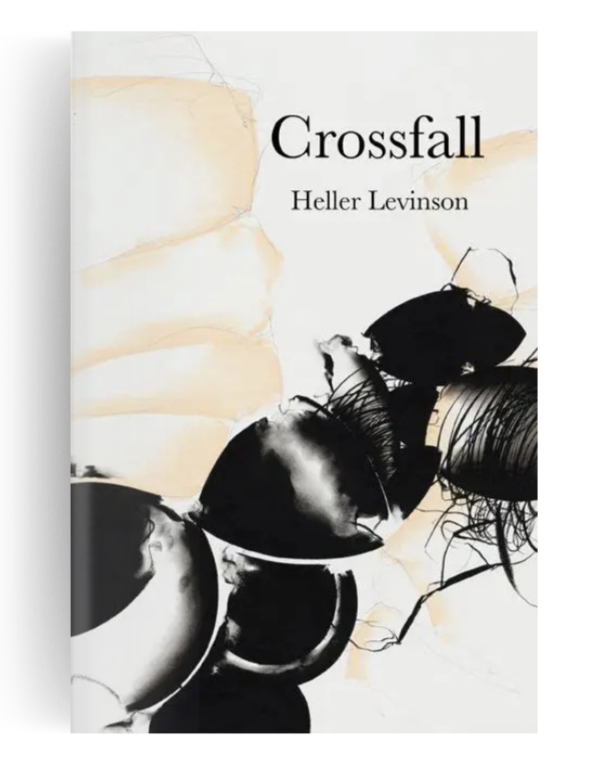
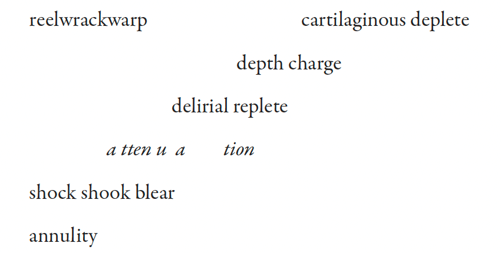
This admonition opens the magnificent collection, Crossfall, by the prolific poet Heller Levinson. This book is a kinetic sculpture of participles, subdivisions, and syllabics welded together in a sinewy, vibrating figure that stretches linguistic possibility. Crossfall continues Levinson’s utilization of the free associative qualities of his previous work, and as has become characteristic of Levinson’s oeuvre, he employs dissonance with a musician’s deftness weaving a contrapuntal quality throughout his writing like a particle accelerator, as illustrated in poems like “CROSSFALL VERTIGINOUS AMBUSH”:
Per “Crossfall Considered,” a crossfall is “The transverse sloping of a roadway toward the gutter or shoulder on either side.” It is the liminal space between the established pathway and the ditch, the rough, the transition between establishment and entropy. Much like the title of the book, there is a sensation of swerving on and off of a highway as the language careens from side to side. However, this sensation of swerving in this liminal space only elicits joy and wonder.
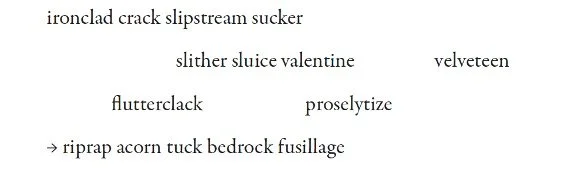
It would be foolish to assume that this is a random assemblage of language. On the contrary, Levinson is a composer and brings his unique sensorial approach to layering his idiolect while building new topographies. This is an architect layering neologisms, ripostes, expository prose, aphorisms, and idioms into a metaphysical conurbation that cascades down the page:
As the reader sets out reading Crossfall, It is incumbent upon them to disabuse themselves of a premeditated lens through which to read these poems. This work demands the reader to experience the text in their bodies, for there isn’t just a musicality at work here, but a physicality that is to be consumed and digested. Having had the privilege of hearing Levinson read his work in person with his smooth baritone voice saturating each consonant and vowel, it is impossible to not feel impelled to read the words out loud in order to experience them in the body.
Truly, Levinson’s writing demands more, and in our era of immediate gratification and penchant for linear outcomes this will cause inevitable tension for readers seeking an “easy” read. But this frustration is entirely the point: Good work should demand the suspension of a desire for a facile approach and instead activate the reader. One should submit to the discomfort. Take the poem, “when calculus abides”:
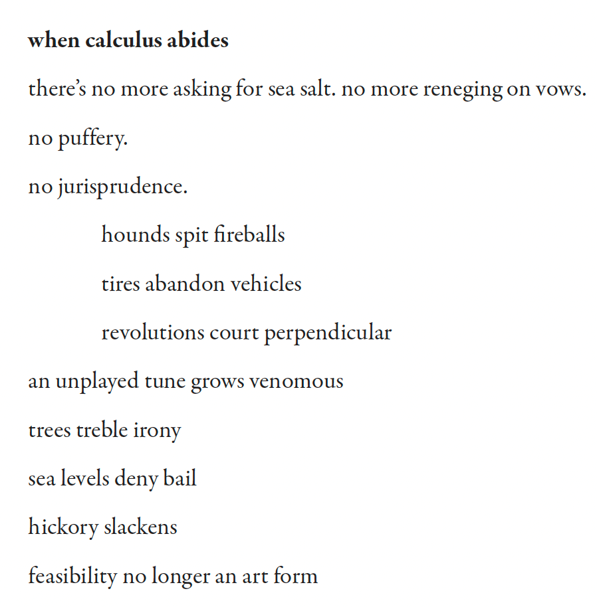
The opening line juts out like a ledge, and with one precarious step, the reader will trip on the second phrase, “no more reneging on vows.” One can imagine a dancer falling down the stairwell of an Escher drawing only to end up on the ceiling of the room she fell out of in the first place, tumbling down the new next two lines, dissolving pretense, and landing in a precarious setting where violence (“hounds spit fireballs”) and the erasure of verities (“tires abandon vehicles”) give way to an intersection of conflict: “revolutions court perpendicular.” As the poem continues to unfold, Levinson unfurls contradictions, which only create more friction with the title of the poem, for none of the formulae presented reveal any degree of predictability, inevitably leading the reader into that liminal space where “feasibility no longer an art form.”
While Levinson’s poetry is certainly in conversation with the likes of Bachelard, Benjamin, and his contemporary, and occasional co-collaborator, Will Alexander, I feel the most complementary example is found in the work of the musician, composer, and philosopher, Anthony Braxton. Much like Braxton, Levinson employs his own epistemological structure encompassing a variety of disciplines to bear on his poetics (see Levinson’s critical framework, Hinge Theory) and what is birthed is a musical composition of exquisite dissonance. Often when reading Crossfall, I find myself thinking of Braxton’s album, New York, 1974, in which Braxton titled the compositions using numerals and illustrations rather than traditional notations. In much the same way I find myself swept up in the dissonant textures and tones of Braxton’s compositions; I am also swept up by the surprising synaptic connections Levinson creates between dissonant words and theoretical frameworks.
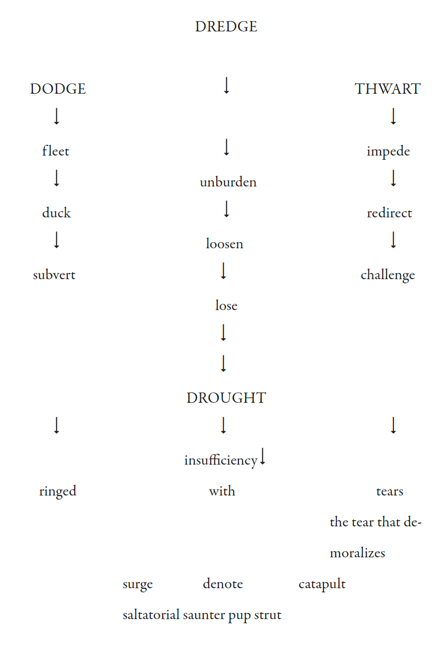
This is just one layer of Levinson’s genius—by forgoing convention, formulae, and formal constraints, he offers the reader an opening to an expansive field of new geometries. It is important to highlight Levinson’s polymathic abilities in his writing. An important feature of all of his output is his capacity to integrate a multitude of disciplines into his poetics. Whether it’s philosophy, mathematics, science, critical theory, or jazz, Levinson stretches these disciplines into a fusion that births a kinetic sculpture like Crossfall. The poem “DESCEND,” for example, invokes the work of the sculptor Richard Serra, borrowing a quotation from Serra’s description of his 2015 sculpture, Every Which Way, in which he compares the labyrinthine quality of the work to navigating the “twists & turns continuously” of a city.[1] As the poem proceeds, it wends its way from critical notes on the intentions of Serra’s work to a diagrammatic map that also “twists & turns” across a breakdown of “dredge, dodge, thwart, and whimsy:”
Richard Serra, “Passages and Intervals,” in Richard Serra and Hal Foster: Conversations about Sculpture (New Haven, CT: Yale University Press, 2018), 144.
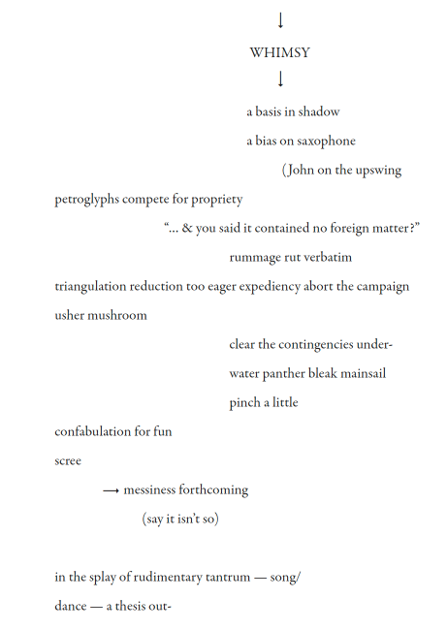
Here, we see Levinson’s ability to play mapmaker, elucidating for the reader the ability of language to hinge from one word to the next, from a critical exploration of Serra’s intentions to a disassembly and reassembly of language charting the movement of the words as they flow down the page in an alchemical deluge.
By every measure, Levinson’s language in Crossfall not only dreams, but soars, builds nations, splits atoms, explodes, and is reborn. If a reader could imagine a poetry collection as a map of subatomic particles, then Crossfall would be that map. As many readers and writers of poetry today search for meaning in a world that continues to fall further down a rabbit hole of performative cruelty, violence, and reason, it would behoove them to dive into Levinson’s work because it’s work like his that pushes us to wrestle with language so that we don’t languish in our own myopia, so we can dream up new connections to explode our preconceived ideas about what poetry should and shouldn’t do. While Levinson notes “messiness forthcoming/(say it isn’t so),” I for one continue to look forward to making more messes and consulting the maps of Levinson’s work in the process.