TRANS ARTIFACTS: bones between my teeth, A Review of Ren Wilding’s new Chapbook from Porkbelly Press
by Courtney Leigh
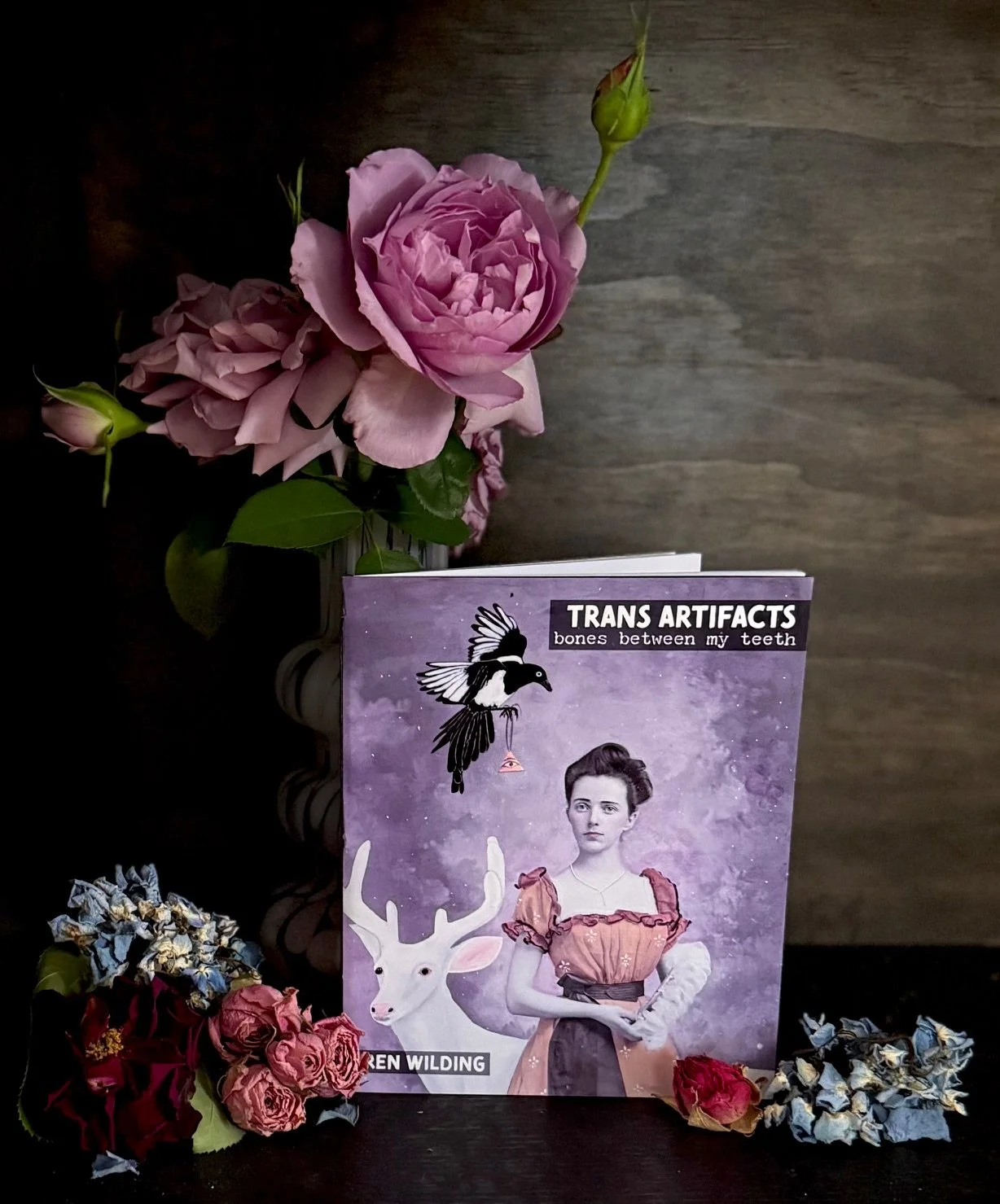
TRANS ARTIFACTS: bones between my teeth by Ren Wilding from Porkbelly Press, 2026
There’s something immediately captivating about this pocket-sized chapbook, the kind of book you feel & admire before you fully read it. The cover, rendered like a watercolor collage, feels both assembled & dissolving, an apt visual threshold for a collection dealing with transformation, rupture, & self-making. It invites you into a body that’s in motion as it sheds, reforms, & remembers.
At its core, Trans Artifacts: Bones Between My Teeth by Ren Wilding traces the experience of a trans speaker coming into being, not as a clean emergence, but as a haunted one. In the very first poem, they say: “I’m trying to give myself / a warning / that my body / will be haunted / by what it sheds” as a recognition that transition is not erasure, but layering. The poems refuse the simplicity of a before & after, instead dwelling in the tension between the perceived self & the lived self, between what was imposed & what is claimed.
That tension is embodied in the sensual language creating visceral moments like: “I am hungry / with growling / I can’t sleep with, / nettles growing out / of my skin.” These metaphors aren’t quiet; they insist on being felt. Even quieter moments, like the poem “Tidepool”, carry an undercurrent of intensity with lines like: “sound muffled / but the water rushes” & “the mollusk of my tongue.” The body here is oceanic, animal, mythic. It is never singular, always shifting.
That shapeshifting of the self becomes part of a broader lore the chapbook weaves through natural & mythical imagery. Animals bare their teeth. Creatures molt, split, regenerate. The speaker aligns their own experiences with these cycles, suggesting that transition is not aberration but inheritance—something ancient, instinctual, & already embedded in nature—& yet, the world the speaker inhabits is often so unkind.
The chapbook holds that reality without surrendering to it. The voice moves fluidly between tenderness & ferocity, soft toward the self & those they love, but unapologetically sharp toward those who would deny their existence. There’s an almost feral defiance in moments that feel like a warning: if they see animal, show them teeth. It’s not just survival, it’s reclamation.
Still, the most affecting lines happen to be some of the gentlest: “Let your dimples / be a memorial / to the ways / you should have been / loved…” holding grief & care in the same breath, mourning an absence while insisting on the possibility of self-given tenderness.
Ultimately, this is a book about becoming even, & especially, when one already is. “My name / a gift to myself / for my becoming” frames identity not as something granted by others, but as something authored from within. The act of naming becomes both intimate & radical.
Rich with imagery, layered with meaning, & unafraid of its own intensity, this chapbook doesn’t just depict transformation, it enacts it. It asks the reader not only to witness becoming, but to feel its weight, its cost, & its undeniable beauty.