Lineage through Spirit & Grit: A Review of Jessica Walsh’s Blowdown
by Fox Henry Frazier
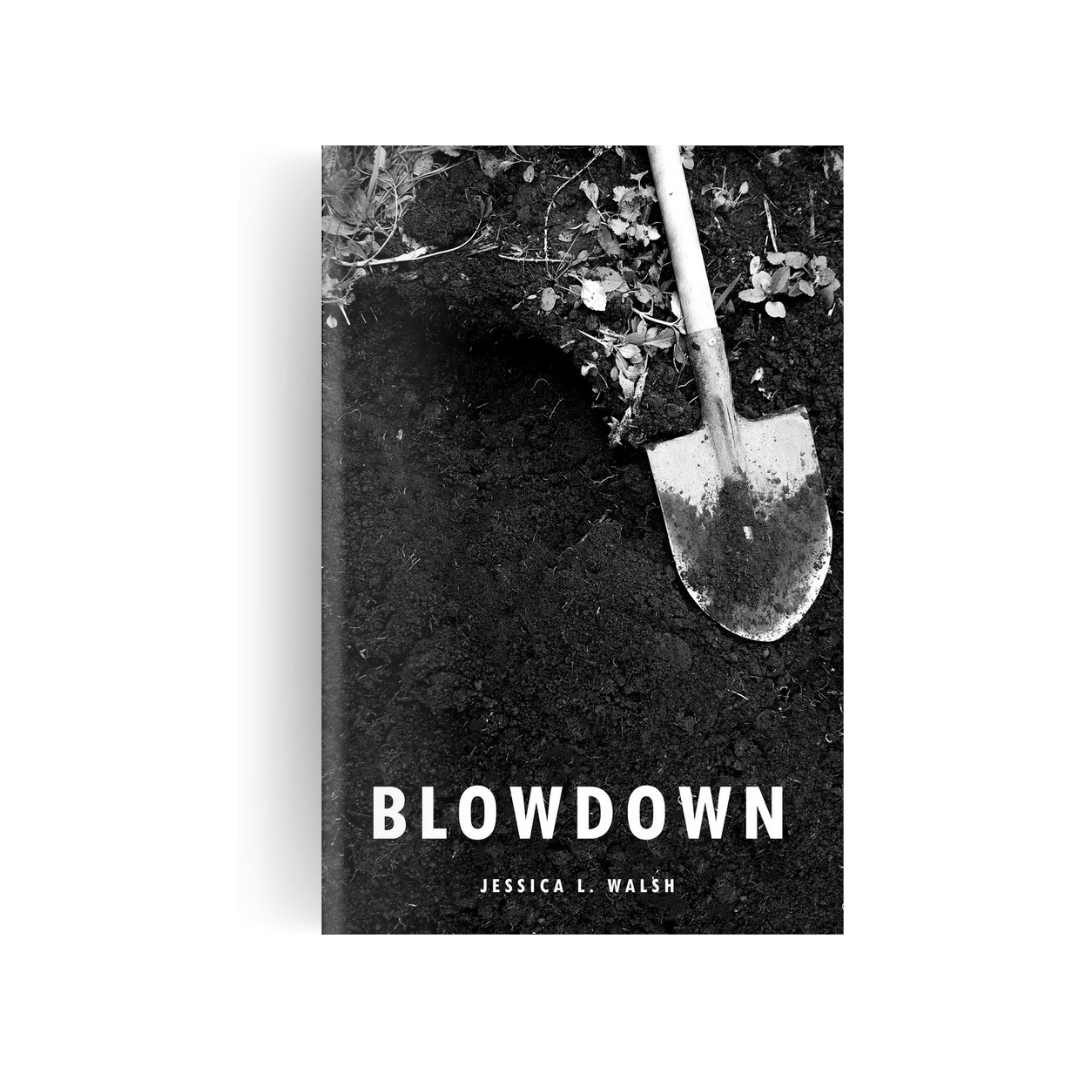
The title of Jessica Walsh’s fourth poetry collection, Blowdown (Small Harbor Publishing, 2026), alludes to arboreal casualties of an act of God — trees felled by wind, as in a storm. This volume focuses on the type of tree that maps family histories; the speaker’s genealogical pursuits guide her to navigate her own interior landscape, along with familial relations and traumas that span generations — and, ultimately, the spiritual terrain that both connects and transcends them all.
The grit of lived experience is presented via physical artifacts in an early poem, titled “What the Lake Gives Back,” a piece that functions almost as an ars poetica for the entire collection. Offering the reader a view of a lake that has receded during a dry spell, “as drought pulls back the curtain/ on all we hid there” (Walsh, 15), the speaker metaphorically expresses the discomfort and liberation that accompany revelation. The refuse and damage once hidden by the lake all become increasingly unwieldy: “beer cans and liquor bottles” are found in the receding lake, to no one’s surprise; but this quickly escalates to larger items: “TVs and fridges, a washing machine.” Finally, larger crimes emerge: “bones . . . mostly the odd tibia or vertebrae,” but “sometimes whole skeletons.” At the climax of the poem, the speaker describes:
“One skull near another.
If they sank together
or if one sent the other
they won’t tell.
Our people die with their secrets
sealed in their mouths.”
(Walsh, 15)
The poem’s final stanza amplifies the anxieties that many artists feel when writing about once-private experiences: “I’m sorry . . . when I write what we tried to hide/ like life itself is nothing/ but imagination.” Walsh’s speaker knows that there is damage and shame to naming things that have been hidden, as much as there is freedom and healing. Yet she is called to do this, by a force within her that seems nearly as strong as the drought slowly swallowing her lake.
As the book continues, we see how the grit of this speaker’s upbringing and family histories have impacted her sense of identity. In “The Needle Meets the Vinyl,” she tells us, “Poets declare you is how the I hides,” and admits that she grew up learning to hide her self as a matter of survival. “I am here means here I am,” she declares in the next lines, as though asserting oneself in any context equals willfully donning a target. In this context, we understand that she is writing about her I, her hiding self, as the poem’s closure describes a strategy for making existence safer:
“You split into a stable of yous
good girl quiet girl skinny girl
busy girl working girl gone girl,
you are all of them just in case
one of you is not in trouble.”
(Walsh, 19)
Young adulthood continues to bring ubiquitous adversities and hostilities. In “A Girl Walks Out of a Bar,” Walsh’s college-aged speaker asks her professor to write her a letter of recommendation — a sign of a student attempting to grow, applying for opportunities that will augment and/or continue their education. The professor’s response, while far from the cruelest abuse in this book, is absolutely appalling: “he said What you should do is open a bar. / Jackson or Flint, maybe. Someplace rough. // He saw me.” The speaker’s resistance to such aggressive classism and misogyny is adaptive; as the rest of the poem explains, this tenacious young student has already learned:
“How to survive in hostile places
like our old-money campus,
like the low chair beside his desk.
He shot himself
before he could see me living
off the long con of a job just like his.
I’m not above believing I won.”
(Walsh, 42)
This vindictive celebration of victory is an expression of the speaker’s desire to protect her still-hiding self. By the time she’s achieved a professorship of her own, she’s had to create and be the safe space in which her self-actualization was allowed to happen. It seems natural that, after being exposed to so much cruelty, she feels a sense of victory at having supplanted the erstwhile establishment-authority figure who tried to keep her down and diminish her. That she achieved it anyway, and that he’s dead and can no longer perpetrate harm — these are what forms of victory the world has shown her, and she may as well enjoy them. The spaces of her job, her classroom, her office, the psychic space in which she is now professor — these spaces, to which he attempted to deny her access, now offer her at least some layers of insulation from the kinds of trouble that make her I hide.
The absence of safety runs deep, for the consciousness behind these poems. In “Multiples of One,” the speaker turns her gaze upon her paternal grandmother who has relocated alone from Michigan to Hawai’i, deliberately severing ties with most of her family. This same woman waited until all of her children, including the speaker’s father, were fully grown adults before she decided to leave the man who viciously abused them for decades. This grandmother represents multiple forms of abandonment: not only did she enable a lack of safety for her own children in their home, but she later eschews the role of familial elder, doubling the abandonment wound for generations. For thousands of years, humans have relied on mutual commitment to safety with those who share our DNA, for both community and survival. The grandmother’s repudiations of this natural law is rendered with nuance, privileging difficult truths over comfort:
“My beautiful cousin tells me over sweet coffee
that she owes her whole life
to the same woman who missed mine.
[ . . . ]
A grandmother who loved one
and let the other fall away.
A mom who hugged her kids
but fed the wolf who hunted them.”
(Walsh, 18)
Despite the ugliness to which they bear witness, these meditations also remind the speaker of her own relationship with Spirit, and the worlds that exist beyond this one. In “The Silence,” a cento composed from lines of her maternal grandmother’s diary, Walsh allows us to see how even recollecting the “rough” details of “a turbulent year” filled with the obituaries of kin, a year that has been “bleak—lonely—humiliating” still provides opportunities to witness the “grandeur and power” of the change called death (Walsh, 27). There is mourning, there is loss, but there is a glimpse of a higher power, something much larger than humanity. In closing lines that could have been written by Emily Dickinson, Walsh, through the words of her grandmother, reminds us:
“Time eternally putting things,
even present things, in the past—
the sun—the leaves moving.
Time all around us—
so silent but rushing! rushing!”
(Walsh, 27)
Spiritual awareness grows as physicality succumbs. In “My Disheveling,” the speaker describes her body as “brick house/ turned tear-down,” reclaiming her power as a person via the epiphany that men are now intimidated by her lack of conventional beauty, by the presence she has achieved with age. They ignore her, don’t bother her, even display mild discomfort in her presence. Relishing this, the speaker looks forward to a day in the future when men will offer her their seats on the bus, “not chivalrous but uneasy / at the sight of a woman eroding.” The loss of nubile youth and the gradual breakdown of the physical body with age bring new kinds of power, to which the speaker finds herself fully amenable. “I am ready,” she says at the poem’s closure, “to join my ghosts and crones” (Walsh 64). The book’s penultimate piece, “Pyre,” finds the speaker marveling that it’s “exhausting just existing / having to love nonstop because this love right now / is over before you can say it” (Walsh, 73). Identifying with fire, the way it “tr[ies] to survive / jumping and creeping to the next new loss / like it will never run out of fuel like it doesn’t need fuel,” she embraces a full life, one that will inevitably include pain and the navigation of hostile spaces because, as she puts it, “one day it will be the last fire / and I’ll be telling you I love you through the thin white smoke.” Even through the veil of death, she will connect with her loved ones; but she doesn’t want to waste a minute of being able to do so directly, humanly, while she still can.
Eventually, the speaker’s relentless gaze moves beyond her project’s initial scope. “I think I want to let you go,” she writes to her ancestors in the final poem, “Bone Road,” before acknowledging that she has perhaps asked too much of them:
“I wanted you to tell me
why it hurts so much to be alive
and what part you had in me
what you started and ended
how you lasted through catastrophe
or made amends for causing it
I wanted you to be why
I’m what I am
to tell me how
I can leave myself behind . . . ”
(Walsh, 74)
But there are things about her existence, both in life and (someday) in death, that cannot be explained by her ancestors. “You’re drops of water/ in the river/ not the river,” she realizes. Of course, her family tree is pieces of her, and she of it. But there are pieces of this life also written by the wider world, and by the gods and Spirit; and, pieces yet to be penned by Walsh herself. The speaker resolves to continue living, creating, and looking for answers — while honoring the spiritual connective tissue that keeps her kin with her:
“Let me ask too much of myself
for whatever’s left of this raggedy life
I release you to the road
where I’ll find you again.”
The conclusion of this beautiful book reminded me of blowdown’s secondary definition: the cleansing of impurities from a closed system, via use of the system’s own internal pressure. A small portion of the system’s resources are intentionally “wasted,” or spent, on driving out the accumulated dreck: a valve is opened on a boiler, for example, so that steam or water pressure can force out accumulated sludge, scale, and other dissolved solids, along with a small amount of good water. The goal is to prevent future, irreparable damage and reduced function. This form of maintenance is designed to absorb a small amount of loss, for the greater good. In applying the pressure of her unrelenting gaze to the closed system of her family, Walsh has perhaps been able to dislodge some of the buildup that has damaged, even plagued, her family tree. In interrogating what she has inherited from her ancestors, she has created a gift for her bloodline in this book — a healing that travels forward and backwards through time and spirit, through lineage and grit.