The Alchemy of Language: Translation & Transmutation in “Ancient Algorithms”
by Courtney Leigh
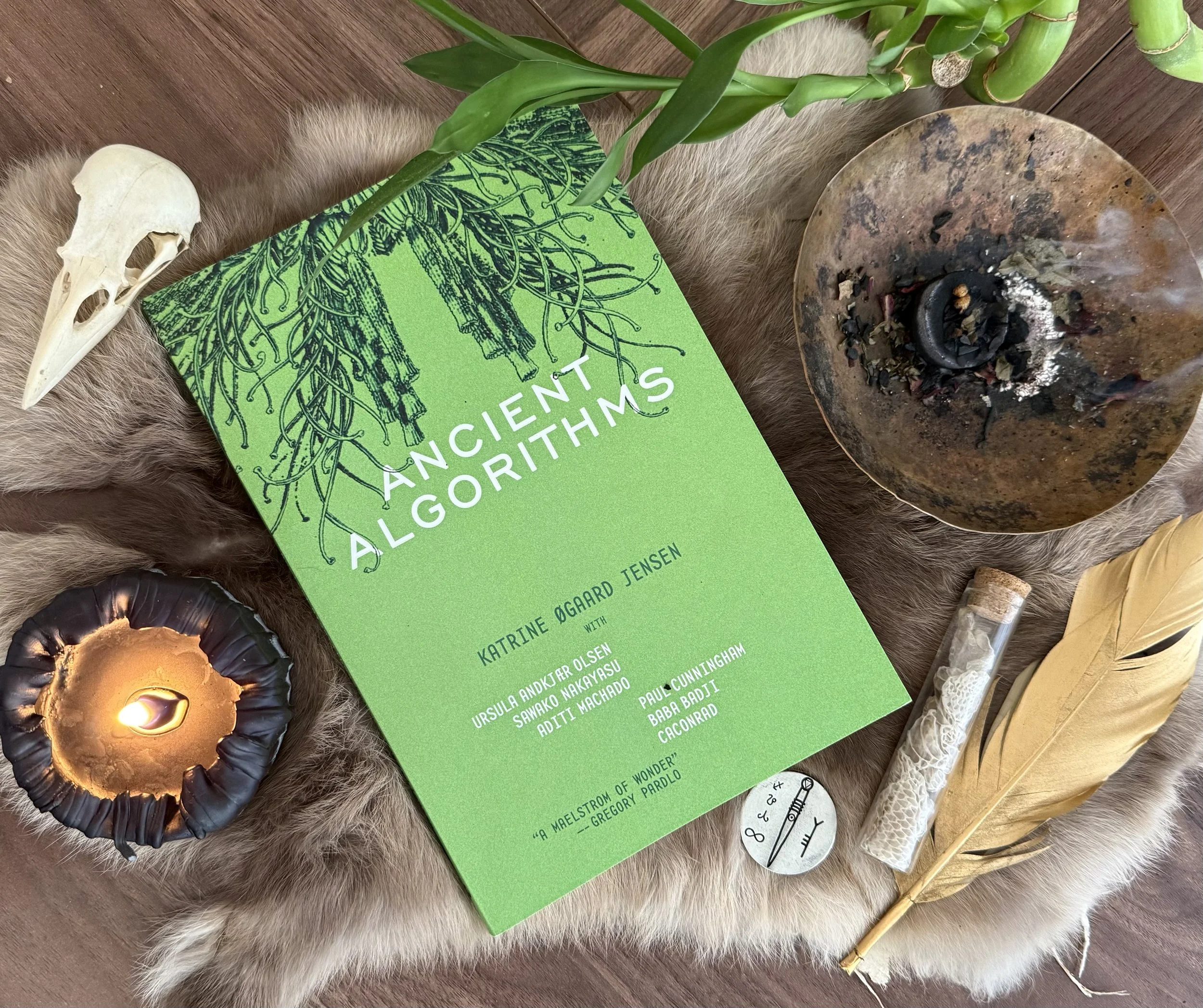
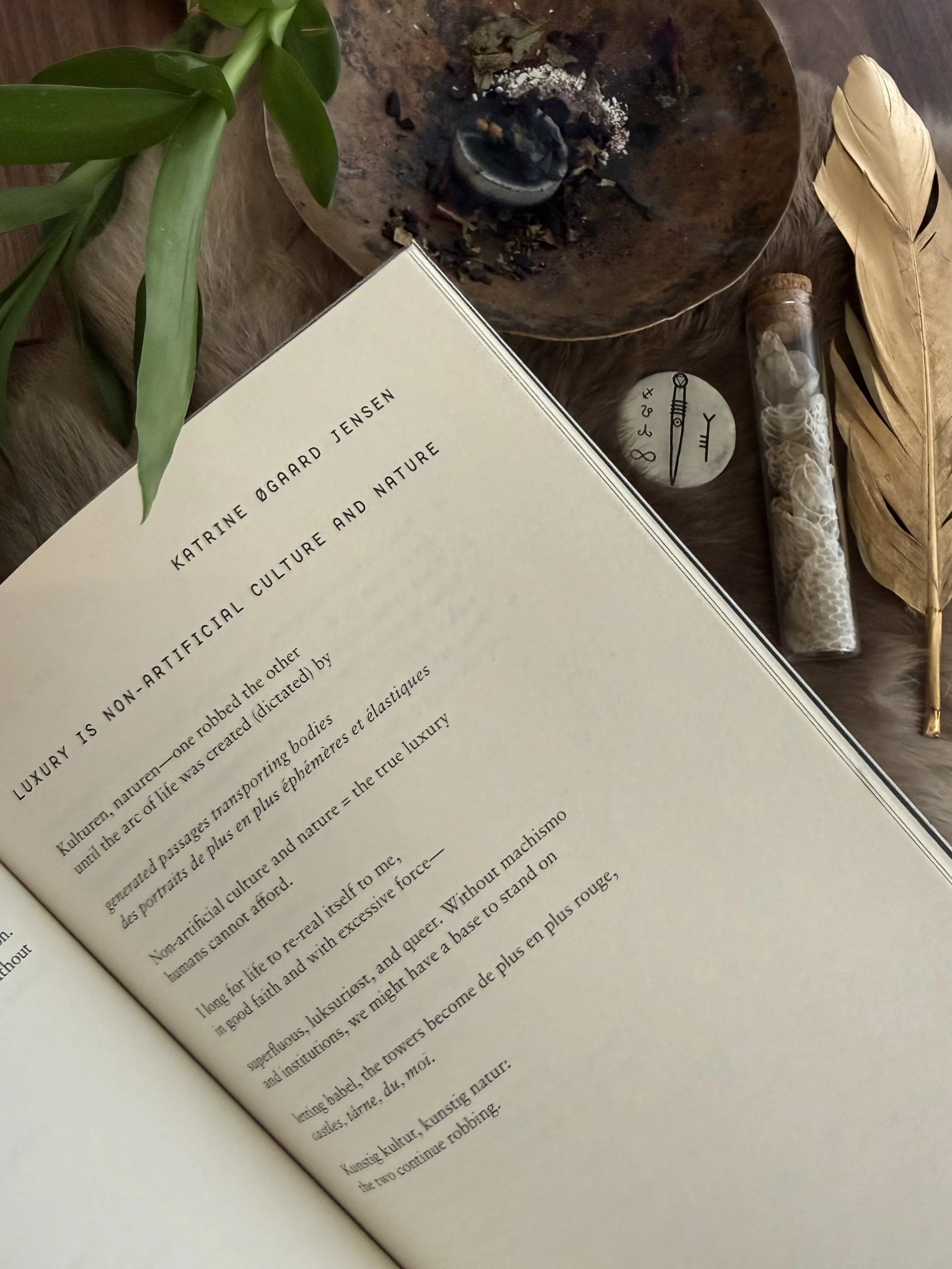
Ancient Algorithms proposes translation not as a faithful transfer between fixed linguistic containers, but as a living, generative art form that thrives on deviation, ritual, collaboration, & intentional error. In this hybrid work, Katrine Øgaard Jensen engages the poetry of Ursula Andkjær Olsen along with poets Sawako Nakayasu, Aditi Machado, CAConrad, Baba Badji, & Paul Cunningham through mistranslation, rewriting, & remixing, guided by a series of self-imposed rules that function as both algorithm & spell. Translation here is not a service to an original text but an active site of creation, where meaning is allowed & encouraged to mutate.
Reading this book, I was immediately struck by previous ideas that all art is a translation of nature, filtered through the singular perspectives we bring to it. This book itself feels like an artifact, one that documents its own emergence & erosion, mapping transmutation not as metaphor, but as lived process. The book employs ekphrastic, divinatory, & digital methods to translate poetry that already exists, foregrounding the non-linear & ever-changing nature of meaning. A poem becomes an input rather than a source, something to be passed through different mediums & consciousnesses by unpacking the processes of thought & imagination, will & intention. Both in writing & in reading, Ancient Algorithms demonstrates how even the smallest shift in elements can generate an entirely new translation. Language behaves like energy; it cannot be created or destroyed, only transformed. Each mistranslation is less a loss than a conversion, a change of state.
One of the book’s central assertions is that writing poetry is itself a mode of translation, just as reading poetry is another. No poem arrives intact; it is translated by the conditions of its reception. Through a lens that resonates with quantum physics, the book suggests there is no single answer embedded within its pages. Instead, truth is contingent & dependent on the observer. Translation becomes both truth-seeking & non-truth-seeking at once, a paradox that mirrors how language operates in the world. The reader & writer rely on their own perspectives to translate, to find coherence, or to accept indeterminacy.
This approach extends beyond human language. Ancient Algorithms implicitly frames human beings as translators of nature, which has its own language, one that precedes & exceeds humanity. Language, then, does not belong to anyone. It is merely a tool for translating nature into symbols, & symbols back into more language. Meaning circulates rather than settles here. For readers encountering the Danish poems without knowing the language, the book offers a quietly radical permission: understanding is not prerequisite. To read without comprehension is still to know something, to encounter a version of meaning unfolding in the present moment. To know the language is to access one truth, to not know is to access another.
Structurally, each section of Ancient Algorithms reads almost like a discrete episode, a reset of rules & conditions. Across the contributions of multiple poets, the poems are strikingly self-aware, as if conscious of their own dreamlike state or their steady flow of thought. They move with an uncanny lucidity, aware of themselves as processes of consciousness rather than products. The poems are rich with the sinews of life & death, binding body to nature, body to language, & language to nature in a cyclical motion. Each section completes a circuit, only to begin another. As the book itself states, “When in mistranslation, we are unfolding language to create & reveal new meaning.” Ancient Algorithms does not ask the reader to decode it. It asks the reader to participate, to translate, to be translated, & to accept that meaning, like language itself, is always in motion.